MCCM
 RESILIENCE
 OUR MEDIA


Exploring the systemic legislative risks to human rights and the rule of law stemming from digital platforms and digital media regulation in Bosnia and Herzegovina [BiH], the Risk Assessment study pinpoints institutional weakness, media systems fragilities, and policymaking fragmentation, highlighting where immediate attention is needed.
Targeted action can safeguard freedom of expression, ensure access to information, and create a more coherent and resilient digital framework if these key issues are addressed: adoption of the media-related laws that recognize the digital dimension of media operations and media market, strengthening institutional capacity, formalizing civil society participation, and boosting cross-institution collaboration.
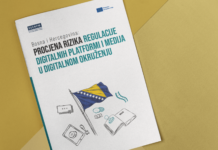
These are key messages of the publication Bosnia and Herzegovina: Regulating Digital Platforms and Media in the Digital Environment – Risk Assessment [in Bosnian] by SEENPM, produced within a UNESCO project “Building Trust in Media in South East Europe: Support to Journalism as a Public Good”, financed by the EU.
The risk assessment is based on an analysis of legislative and policy monitoring processes conducted from December 2024 to May 2025.
Findings identify key priorities requiring prompt stakeholder intervention in BiH’s digital platform regulation and media environment. Detailed recommendations are provided later in the text.
- Adopt media-related laws and regulations to bolster an enabling environment for media freedom and freedom of expression, including laws related to media pluralism and transparency, electronic media.
- Strengthening Institutions – Current institutions often lack political will and independence, as well as financial resources, while facing staffing and funding shortages, limiting their ability to operate effectively.
- Boosting Cross-Institution Collaboration – Greater coordination between institutions is key to aligning policies and creating a more consistent, coherent approach to both legislation and enforcement.
- Formalizing Civil Society Participation – A permanent and funded multi-stakeholder forum should be set up to bring together civil society organizations, academia, independent experts, media associations, and journalists. Their expertise can ensure that policymaking in media regulation and digital governance reflects public input and produces clear, effective legal standards.
The publication is part of a broader series of studies covering Albania, Bosnia and Herzegovina, Montenegro, North Macedonia, Serbia, and Türkiye.
The integral – regional collection publication [in English]: Regulating Digital Platforms and Media in the Digital Environment: Risk Assessments
When Political Deadlock Holds Back Reform
The analysis highlights a fundamental point: in BiH, the digital platform regulation faces a serious lack of political will and legislative vacuum. In countries where institutions and media systems are weak and where central media legislation is lacking, poorly implemented platform rules can do more harm than good.
BiH has pursued EU membership for several years and regularly commits to aligning its media and digital regulations with the EU acquis. Implementation, however, is often obstructed or delayed, and while there is broad agreement on the legislative media reforms needed, disputes remain over jurisdiction and regulatory responsibility.
In the meantime, Republika Srpska has initiated the adoption of its own Law on Media, and some cantons (Una-Sana and Sarajevo) have attempted to regulate misinformation on the internet, which would lead to further fragmentation of the already fragmented legal and policy landscape. None of these laws has been passed so far.
If state institutions can overcome the current political deadlock, this could pave the way for the adoption of essential structural media laws, creating a strong foundation for alignment with the digital platform regulation. However, successful regulation in BiH depends on efficient adoption and implementation of the media-related laws and continued support from the EU [the latter is true for other Western Balkan countries, as well].
BiH lacks a comprehensive digital strategy to guide digital infrastructure development, improve services, and ensure coordinated modernization of public administration and the economy.
Cybersecurity and information security are still not systematically regulated, as key strategies on cybersecurity and AI development have not been adopted, leaving significant gaps in protection of the digital space.
As a result, BiH and its institutions remain highly exposed to cyber threats and attacks, while lacking clear mandates and mechanisms for crisis response.
Weak coordination across government levels and limited political will further slow the development of an effective legal framework for safer and more efficient digital governance.
These gaps create a broad rule of law risk and further expose human rights, including through cyberattacks targeting independent media, journalists, and the wider public.
However, there are rare positive examples of state-driven progress in this area. The BiH’s Law on the Protection of Personal Data was adopted, aligned with the EU General Data Protection Regulation (GDPR). This represents an important step towards harmonisation with European standards.
Stronger Institutions, Safer Digital Spaces
In response to these overlapping risks, and to reinforce media freedom, digital rights, and democratic governance, the following recommendations are proposed:
- EU-aligned legislative strategy. Adopt media, AI, and digital governance laws in line with the EU acquis, prioritising electronic media, electronic communications, and media ownership transparency to support online platform regulation. Develop a national strategy to transpose and implement the Digital Services Act (DSA), ensuring coordinated and effective legislative and institutional action.
- AI and cybersecurity policy development. Create state-level policies for AI and cybersecurity based on sector-specific vulnerabilities and expertise, and implement responsive measures where needed.
- Institutional capacity-building and independence. Strengthen key regulatory bodies, particularly the Communications Regulatory Agency and the Personal Data Protection Agency, guaranteeing independence, adequate resources, and robust capacities. Formally recognise the media self-regulatory body as regulators’ partner.
- Inclusive and transparent policy dialogue. Engage civil society, media organisations, and independent experts as equal partners in policymaking on media, AI, and digital governance to ensure ethical, accountable, and rights-based outcomes.
- Withdrawal of restrictive legislation. Remove unclear Criminal Code provisions, including those criminalising defamation, and avoid vague or overly broad media laws that could undermine human rights and democratic values.
- Media and Information Literacy (MIL) strategy. Adopt a national MIL strategy following UNESCO guidelines to help citizens – especially vulnerable groups, women, and girls – critically and safely engage with online content and digital technologies, building resilience to manipulation and disinformation.
Charting Digital Governance Risks: A Methodological Framework
The assessment is based on a bespoke, replicable risk matrix, structured around three risk groups:
- Misalignment with international standards of human rights protection and rule of law;
- External and internal risks: external risks stem from the broader context (e.g. political climate or potential misuse), while internal risks arise from the regulation itself, including legal gaps, weak or missing redress mechanisms, and loopholes;
- Legislative process factors refer to risks related to how a law or policy is developed, including transparency, stakeholder and expert involvement, and potential political influence during drafting and adoption.
Bosnia and Herzegovina: Regulating Digital Platforms and Media in the Digital Environment – Risk Assessment [in Bosnian]
The integral – regional collection publication [in English]: Regulating Digital Platforms and Media in the Digital Environment: Risk Assessments
This article was produced within the UNESCO project “Building Trust in Media in South East Europe: Support to Journalism as a Public Good”, financed by the EU.
The designations employed and the presentation of material throughout this article do not imply the expression of any opinion whatsoever on the part of UNESCO or the European Union concerning the legal status of any country, territory, city or area or its authorities, or concerning the delimitation of its frontiers or boundaries.
The authors are responsible for the choice and presentation of the facts contained in this article and for the opinions expressed therein, which are not necessarily those of UNESCO or the European Union and do not commit the Organization.