MCCM
 RESILIENCE
 OUR MEDIA


Through the project “It Can Be Different”, magazine eTrafika teaches young people from communities in Bosnia and Herzegovina without journalists or media how to become the voice of their own communities.
Today, in Drinjača, Vojo Mojović practices a somewhat forgotten craft — bow making. Dragica Stanišić from Zvornik turned to beekeeping, which, in addition to helping her personally, also benefits nature. In Priboj near Lopare, Anđelko Delić and his family still grind flour in the traditional way. In the absence of activities for young people, Duško and Željko Jokić came up with the idea to organize a football tournament in Glamoč. Aleksandar Riđošić, a law graduate from Zvornik, decided to devote his free time to bringing the local theater scene back to life.
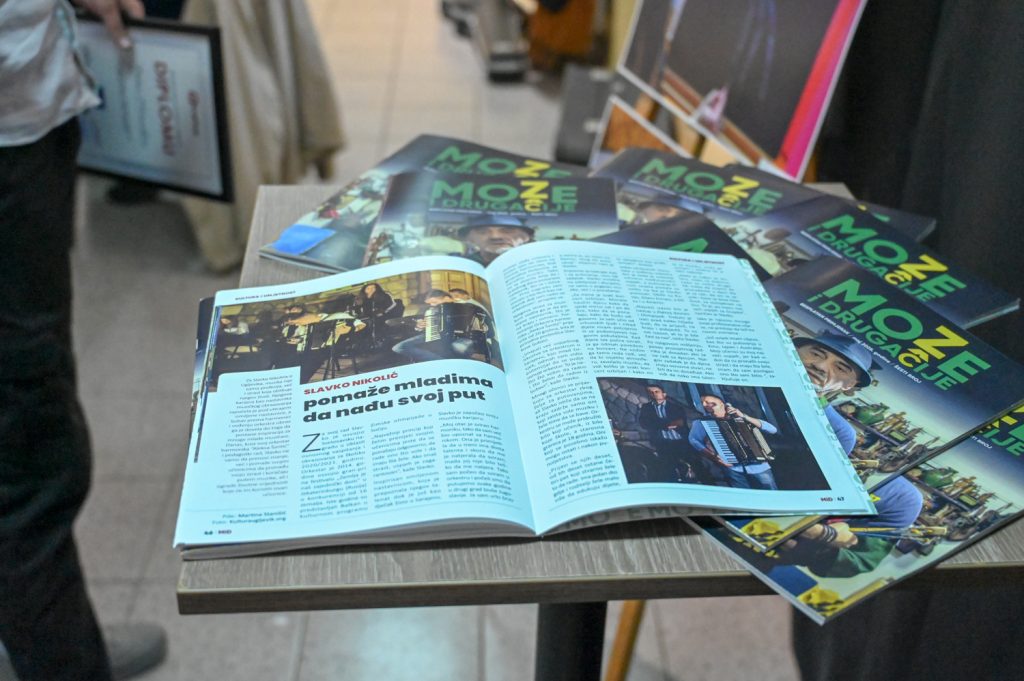
These are excerpts from several stories produced within the “It Can Be Different” program. The stories and accompanying photographs were published on the eTrafika portal, which focuses on reporting about human rights, marginalized groups, and social issues such as corruption and nepotism. They were created as a result of workshops for young people learning writing and photography under the mentorship of eTrafika editor Vanja Stokić and photographer and cameraman Ajdin Kamber.
The program has been running for more than ten years, with or without donor support. The idea is to bring together ten young people from ten cities to learn about journalism. They go through intensive training sessions and then head out into the field. While in the field, mentors follow the progress of their stories. Once a story reaches its final form, it is published.
Vanja Stokić says the principle is simple. They choose people who have no connection to journalism — they neither work for the media nor study journalism. Apart from being consumers of media content, these trainings are their first contact with the media. The stories mostly come from underrepresented municipalities. Vanja Stokić says those municipalities are like media deserts.
“We realized that stories with a positive tone are a good way to enter the world of journalism. Such stories are praised and shared on social media. Negative comments that could discourage the author appear only rarely.”
After the cycle of workshops is completed and the stories are published, a final event is held in one of the municipalities the authors come from. This year, it took place in Lopare. In addition to having the opportunity to talk with the authors, visitors could also meet the people their stories are about.
“Through this program, we look for people who could work with eTrafika, and everyone who is currently part of our team has gone through our training. This year, out of ten participants, five are collaborating with us. Out of those five, four are working on new stories. We even manage to find them a fee.”
The “It Can Be Different” program gives young people the opportunity to experience what a story is, how it is created, and what role they can play in that process. In addition, the program allows them to see how the media work — how topics are chosen, how they are approached, and why they matter. They learn what the media are and how they should be consumed.
The project is funded through the Our Media sub-granting scheme, which has provided support to 21 local projects across the Western Balkans.

The regional program “Our Media: A civil society action to generate media literacy and activism, counter polarisation and promote dialogue” is implemented with the financial support of the European Union by partner organizations SEENPM, Albanian Media Institute, Mediacentar Sarajevo, Press Council of Kosovo, Montenegrin Media Institute, Macedonian Institute for Media, Novi Sad School of Journalism, Peace Institute and Bianet.
This article was produced with the financial support of the European Union. Its contents are the sole responsibility of Mediacentar Sarajevo and SEENPM and do not necessarily reflect the views of the European Union.