MCCM
MCCM RESILIENCE
 OUR MEDIA


Cross-border reporting is no longer just one of the options in journalism; it is increasingly becoming essential for financial sustainability and investigative reporting, as emphasised at the regional Editors’ Forum bringing together editors and experienced journalists from across the Western Balkans.
The third Editors’ Forum, which traditionally brings together media professionals from Bosnia and Herzegovina, Serbia, Montenegro, North Macedonia, Albania and Kosovo, was held in Sarajevo on May 14 and 15. The event „Journalism Without Borders“ gathered editors, senior journalists and representatives of civil society media organisations, this time with a focus on the importance and challenges of cross-border reporting.
Speakers shared insights into funding opportunities for cross-border journalism projects, as well as first-hand experiences from the field, giving participants a deeper understanding of the various opportunities that open up when a newsroom decides to engage in this type of journalism.
For media outlets across the Western Balkans, financial sustainability is becoming an increasing challenge, and cross-border collaborations are often avoided due to logistical complexity as well as the financial resources such projects require. Participants at the event were introduced to grant opportunities available to those newsrooms that have a developed story idea and a reporting team already in place.
Finding the right team
Gathering key information in advance as a solid foundation for the application is important, said the Ronald Tipan, project coordinator at Journalismfund Europe, an organisation that has for years provided grants for various types of cross-border projects. Special attention should also be paid to several factors when assembling a team.
„The most important thing to consider when creating a cross-border journalism team is if the team member(s) matches your processes, work and personality. Journalismfund Europe has been engaged in just a few team dynamics issues and we always advice to pick the best partner that you can work with and if you’re able to work with that person.“
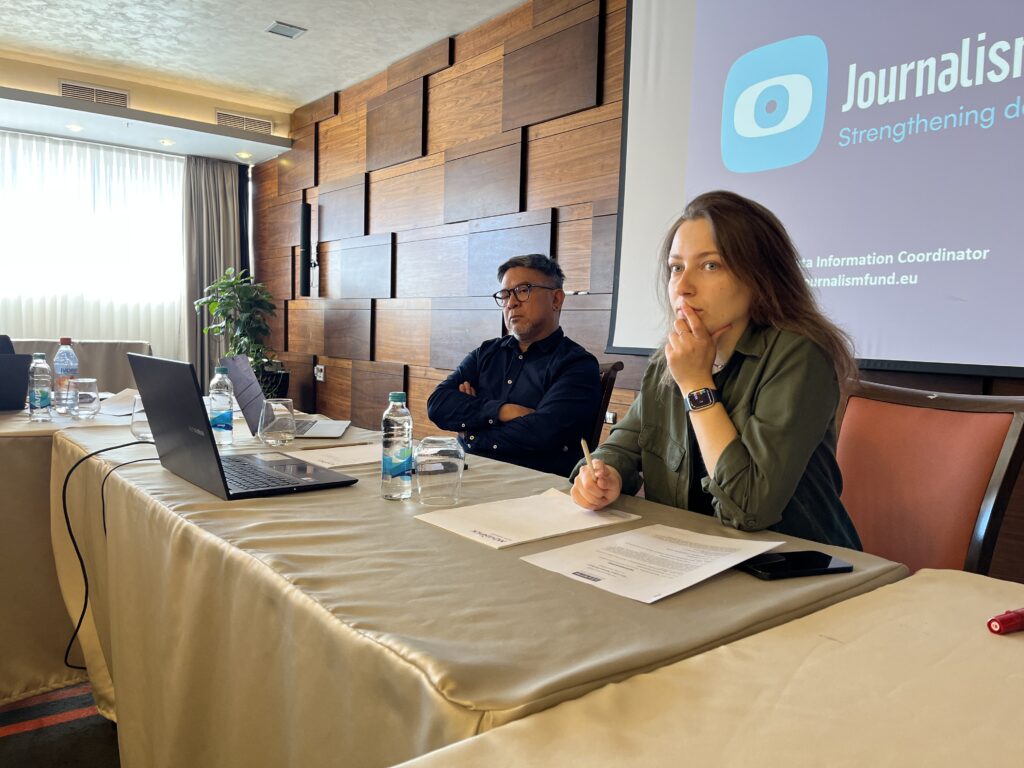
Viktoriia Hubareva, a journalist from Ukrainian media Rubryka with extensive experience working on investigative cross-border projects, shared advice on how to find the right team. For those working on such a project for the first time, she recommended collaborating with people or teams who already have this kind of experience, as they understand the rules, challenges and logic of this type of cooperation.
„It is also important to discuss expectations from the very beginning: how you will work, who is responsible for what, how decisions will be made, what the deadlines are, and what the final result should look like. This helps avoid misunderstandings, especially when people work in different countries, languages, and editorial cultures.“
Hubareva also stressed the importance of agreeing in advance on the workflow and tools to be used, including who would be responsible for OSINT if needed, which services or tools would be required, whether field research would be necessary, and which communication channels would be used. Security and data protection, especially when working with sensitive information, sources or documents, should also be discussed from the outset
AI in Cross-Border Reporting
Participants were also introduced to recent changes to journalistic codes of ethics across the region, with a particular focus on the use of artificial intelligence in reporting. Revised versions of numerous ethical codes in the region now highlight the importance of the ethical and professional use of AI. The topic was presented by Aida Hadžimusić Duratović, an experienced journalist and communication trainer.
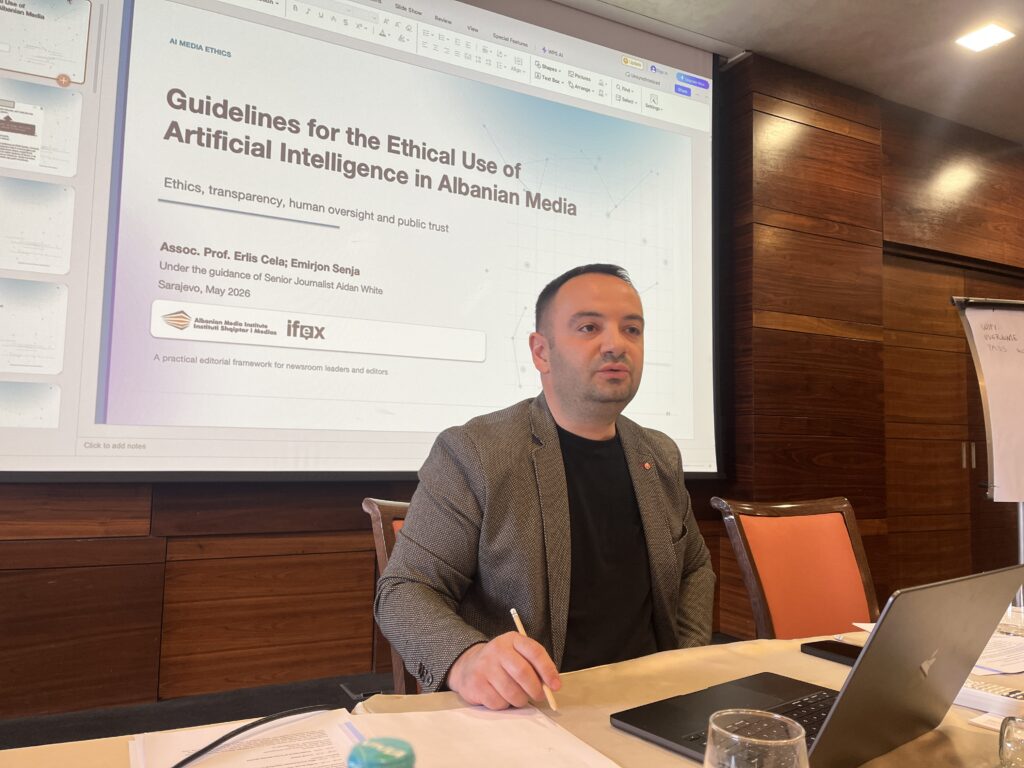
In Albania, a practical handbook on the use of AI has also been developed, offering detailed guidance on how to approach specific situations, such as transparently disclosing when AI has been used to create certain content or drafting explanations for audiences on how newsrooms use AI in their work. The guidelines, available in Albanian and English, were presented by Emirjon Senja, a journalist from Albania and one of the authors of the guidelines.
Together with Amina Vatreš, a teaching assistant at the Department of Communication Studies at the University of Sarajevo’s Faculty of Political Sciences and a PhD candidate whose dissertation focuses on AI, participants also discussed the use of AI in cross-border reporting.
A special part of the programme was a visit to nearby Mount Trebević, where the editors toured the bobsleigh track built for the Sarajevo Winter Olympics and spoke with renowned Bosnian journalist Boro Kontić about international media coverage of the 1984 Olympics and what cross-border cooperation among journalists meant during that period.
New Goals After the Editors’ Forum
The event in Sarajevo gave editors an opportunity to meet and connect with one another, as well as to potentially establish cooperation on future joint projects. Opportunities for editors from across the region to gather and discuss the challenges of today’s editorial profession and the sustainability of media in uncertain times are rare. Enes Radetinac, a founder of A1 Media from Novi Pazar in Serbia, confirmed this, saying that before attedning the Editors’ Forum he didn’t fully realised how important it is to have opportunities to exchange experiences.
„Honestly, I would gladly participate in these kinds of trainings whenever possible, because they generate new ideas and perspectives that I would probably not develop on my own. At the same time, exchanging experiences is very valuable when it comes to topics we all face in our societies.“
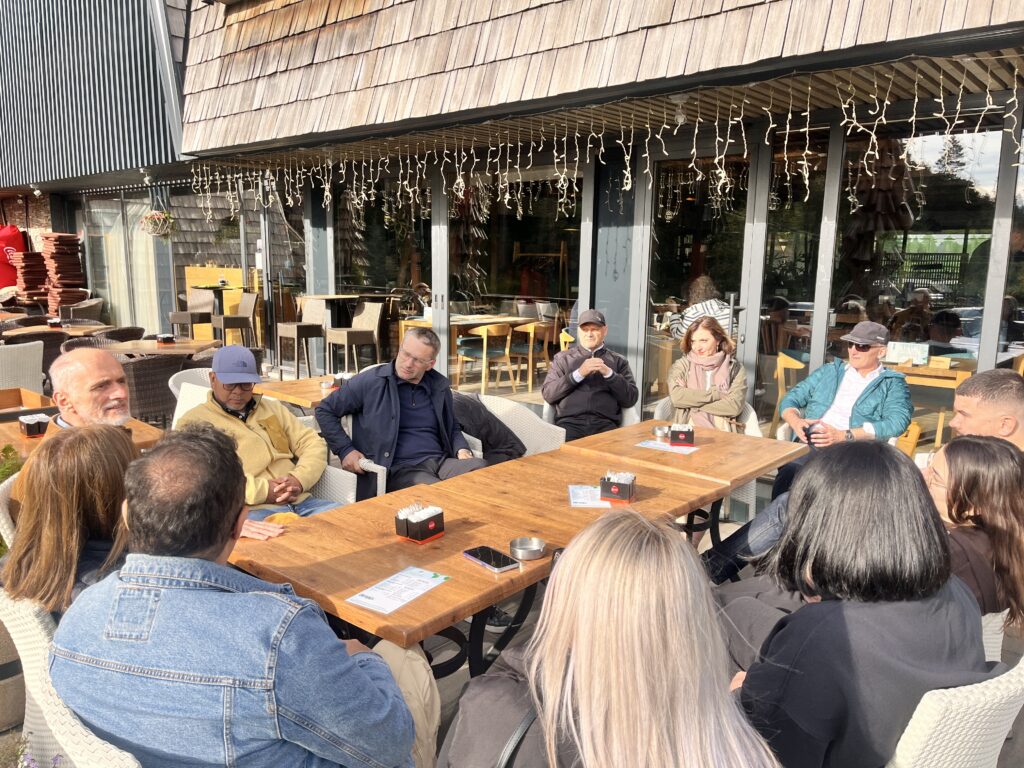
Ivan Kuzmanovski, editor at TV Sitel in North Macedonia, said that he usually exchange experiences with colleagues from the Western Balkans during major regional events or when there is a need for specific cooperation.
„However, I believe it would be very valuable to have these kinds of exchanges on a more regular basis.“
The Editors’ Forum inspired Enes and Ivan to give more space to cross-border stories in the media outlets they work for in the future.
„I realized how important it is to work on cross border stories. In fact, we are already preparing to apply for a new project focused on women, together with organizations from Bosnia and Herzegovina, Montenegro, and Serbia. That became one of our new goals after the event, because I truly believe that many of our stories are deeply connected and that we, as societies in the region, are connected as well“, concluded Enes Radetinac.