MCCM
 RESILIENCE
 OUR MEDIA


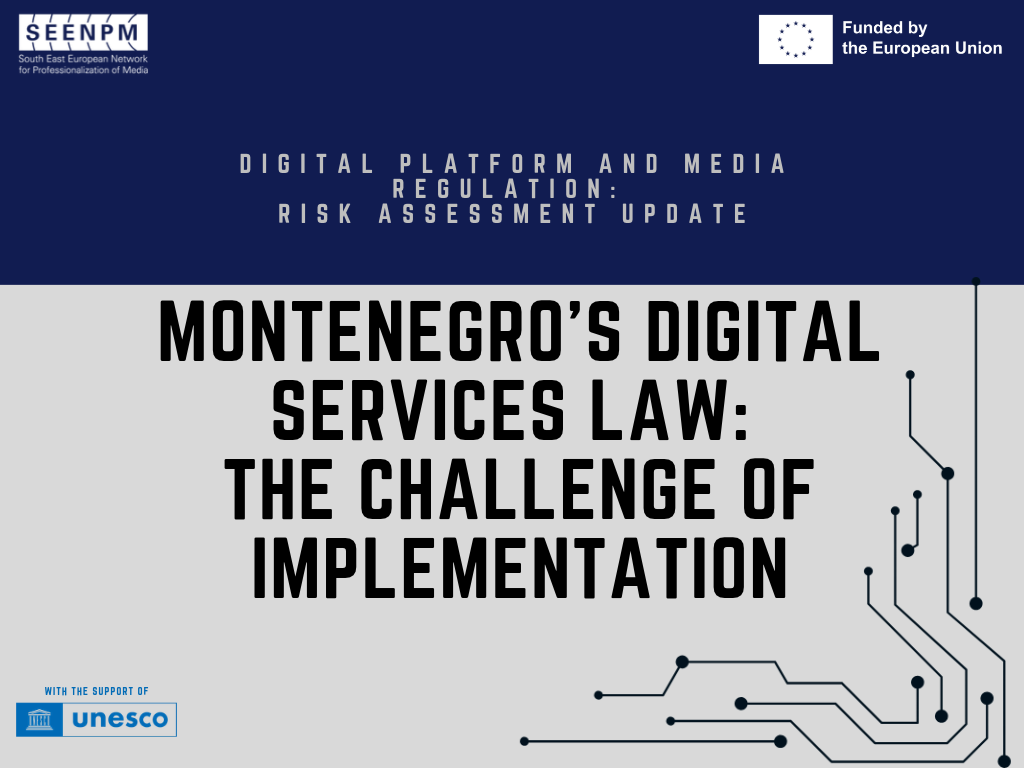
Montenegro has adopted legislation preparing the ground for implementation of the EU’s Digital Services Act. Looking forward, the next period should focus on ensuring regulatory independence, building institutional capacity, strengthening inter-institutional cooperation and maintaining multistakeholder engagement, with the overarching aim of establishing an environment that enables the protection of users’ rights.
By Snežana Nikčević
Edited by Bojana Kostić
Introduction
Montenegro’s regulatory framework has entered a different phase since the previous risk assessment, conducted in 2025 by SEENPM within the UNESCO project Building Trust in Media in Southeast Europe, funded by the EU. The Law on the Implementation of Regulation (EU) 2022/2065 on Digital Services (The Law) was adopted by Parliament on 8 October 2026, following the submission of a revised Government proposal in September 2026 and the introduction of eight amendments. Recently, Parliament also adopted the new Law on Personal Data Protection. These developments narrow some of the legislative gaps identified in the earlier assessment and open the question of the institutional readiness for implementation.
In parallel, Montenegro also advanced preparations for the implementation of the Digital Markets Act (DMA), worked on a Roadmap for alignment with the European Media Freedom Act (EMFA) and progressed with the development of its first Artificial Intelligence (AI) Strategy.
The adopted Law establishes the institutional and procedural basis for Montenegro’s future application of the DSA (Digital Services Act), with an important caveat: its full implementation and enforcement are conditioned upon the country’s EU accession. The Law’s entry into force will initiate a pre-accession preparation period covering funding, technical resources, institutional capacity, staff recruitment and training, secondary legislation, and inter-institutional cooperation. In addition, the Law specifies the role of the national digital service coordinator (DSC), removal orders concerning illegal content, non-compliance sanctions, resources required for the effective functioning of the DSC and the functioning of grievance mechanisms. The Agency for Audiovisual Media Services (AMU) is designated as the sole national competent authority and DSC (Article 4, also strengthened through amendments). The proposal provides for a guaranteed minimum allocation of 0.05% of the current state budget for DSA supervision and enforcement to AMU (Article 9).
The main implementation risks no longer stem from the absence of legislation, but from the need to ensure coherence across multiple regulatory frameworks, strengthen institutional capacities and develop sustainable inter-institutional coordination mechanisms – it is from these perspectives that the following human rights, rule of law and multistakeholder risks are analysed.
1. Human Rights Risks
The Law brings Montenegro’s platform governance framework closer to the EU standards. By introducing obligations concerning transparency, notice-and-action mechanisms, grievance mechanisms, and institutional oversight, the framework follows the rights-based approach embedded in the DSA, and also underlined in the UNESCO Guidelines for the Governance of Digital Platforms.
The principal question is whether, and through what mechanisms, DSA-related supervision and enforcement can operate before EU accession. For example, the explanatory material notes that delaying adoption would mean “entering the upcoming electoral cycle without sufficiently developed institutional capacities in the field of digital services.” It remains unclear how authorities will address these electoral risks before the Law becomes fully applicable. In an interview conducted for this assessment, the Ministry of European Affairs indicated that it was consulting European partners on a possible mechanism.
An additional potential risk concerns the effectiveness of grievance mechanisms. The framework envisages trusted flaggers and out-of-court dispute settlement bodies (Article 4, Draft Law). By merely referencing the relevant Article 21 of the DSA, the Law does not specify criteria for designation procedures and required expertise. Without these criteria and safeguards – where, for example, the core principles are set out in the law itself and detailed rules developed in bylaws – it remains uncertain whether the designation process will function as intended.
Article 7 of the Law notably does not name the specific authorities empowered to issue orders against illegal content or orders to provide information. Instead, paragraph 2 defers this question to a future “special law” (“poseban zakon”), which will need to define the specific authority, the conditions for issuing such orders, and the available legal remedies. This approach aligns with the DSA’s own architecture: Articles 9 and 10 do not themselves confer new powers on national bodies – they merely regulate the format and cross-border effect of such orders once a Member State’s domestic law grants a specific authority.
The special law should be developed through a transparent and inclusive process and clearly identify the competent institutions, their mandates, and safeguards for their independence and accountability. Only institutions subject to public, parliamentary and judicial scrutiny should be empowered to issue orders for the removal of illegal content. The law must also establish safeguards and remedies to ensure that removal procedures comply with freedom of expression standards, including those set out in Articles 26–28 of the UNESCO Guidelines.
2. Rule-of-Law Risks
The implementation of the upcoming law may face several structural barriers that can affect oversight and enforcement: institutional capacity and independence, jurisdictional enforcement challenges, and fragmented coordination across the wider digital governance ecosystem.
Institutional capacity, independence and sustainable resources
The Law designates the AMU as the sole national competent authority and DSC. It provides for independent exercise of the Agency’s functions and introduces a guaranteed minimum allocation of 0.05% of the current state budget for its DSA responsibilities.
The proposal also creates a pre-accession preparation period covering staffing, training, technical capacity, cooperation and operational procedures. These changes address an important weakness identified in the earlier draft, but they do not remove the implementation challenge, especially considering the wider Montenegrin context related to the independence of the regulatory bodies.
Guaranteed funding does not by itself ensure regulatory independence. The European Commission’s report on Montenegro identifies safeguarding the media regulator’s independence as a key concern under Chapter 10. Concerns raised by civil society and at an AMU conference about the appointment of AMU Council members further underscore the need for safeguards against political interference.
The Law specifies in two instances cooperation of AMU with other authorities. For example, Article 4(4) notes that “the Agency coordinates cooperation with domestic judicial, prosecutorial, administrative, and regulatory authorities and inspectorates, without prejudice to their competencies established by special laws” and Article 11(6) mandates these bodies to respond to the AMU’s requested information and data. Amendment VI clarifies that the Agency remains the sole competent authority and DSC under the DSA, while other domestic authorities contribute to coordination and cooperation within their existing sectoral competences. In the course of establishing required inter-institutional coordination in the pre-accession stage, it is crucial to develop in-depth mechanisms of cooperation, where models in France and Germany can serve as case studies.
Fragmented Institutional Coordination and Jurisdictional Enforcement
The DSA intersects with personal data protection, cybersecurity, consumer protection, artificial intelligence, media regulation and fundamental rights. The implementation of the new Personal Data Protection Law, the information-security framework and the emerging cybersecurity architecture needs to be coordinated with the future DSA framework. Without structured information-sharing and coordination, and an overall supervision structure, responsibilities may become fragmented and enforcement ineffective. This again highlights the importance of inter-institutional cooperation, which should be a guiding principle of effective supervision rather than an afterthought.
The nature of the DSA calls for horizontal, rather than strictly hierarchical, mechanisms of inter-institutional and cross-sectoral cooperation, mechanisms that remain underdeveloped in Western Balkan governance systems. Thus, these horizontal mechanisms must be prescribed for this process to emerge. Recent institutional developments illustrate the importance of these safeguards, because conflicts between supervisory, management, and appointment functions can affect institutional credibility.
3. Multistakeholder Governance Risks
The DSA drafting process represents a comparatively positive example of multistakeholder legislative development in Montenegro. The Ministry of Culture and Media established an inter-institutional Working Group and organised consultations involving public institutions, regulators, civil society organisations, academia and international partners. The drafting process was also carried out in cooperation with the European Commission and the Council of Europe, reflecting the cross-sectoral nature of platform governance.
The consultation process and the latest revisions to the proposal also point to a broader and pertinent “conundrum” in the legislative process. Only two formal submissions were received during the public consultation, while the proposal submitted to Parliament contained a substantial number of changes compared with the version put out for consultation. Several of these changes improve the framework, including changes made following technical engagement and advisory review of the EU institutions.
Although several changes improve the framework, their scale maked the evolution of the text difficult to follow and risked undermining the transparency of an initially open legislative process. This is relevant beyond the DSA process itself. In Montenegro, substantial changes between working-group drafts, consultation versions, government proposals and later parliamentary amendments have occurred in other legislative processes.
Regulatory Forecast
One risk trajectory would involve formal adoption without sufficient operational preparation. The institutional framework would exist on paper while the implementation process fails to equip the future DSC with sufficient specialised staff, technical capacity, implementing guidance or sustainable coordination mechanisms. This could produce a normative framework without equivalent supervision and enforcement readiness. A second trajectory, which would lead to a more positive outcome, would focus on institutional preparation before full enforcement and using the pre-accession period to establish the coordinator’s resources and expertise with clearly designated competent authorities, formalise inter-institutional and cross-border cooperation, prepare implementing bylaws and operational procedures, and develop structured channels for multistakeholder participation.
During the current pre-accession period, the explanatory material places particular emphasis on institutional readiness for the upcoming elections. As noted in the explanatory material, under Digital Risks and Upcoming Election Cycle, “a functional DSC, developed cooperation mechanisms, and expert capacities represent an important part of the state’s broader institutional readiness to protect users’ rights and the integrity of the digital space.” It remains unclear how the emerging supervisory institutional infrastructure can be put in place in this in-between period to start achieving this important milestone.
Recommendations
Based on the assessment and as similarly concluded at the national consultations led by UNESCO and Partners Serbia across the region, including in Montenegro, focused on the improvement of the governance of digital platforms and online media, the main recommendations are:
1. Shift the focus to strengthening technical, operational and financial institutional independence and readiness
Montenegro has largely completed the legislative preparation phase. Future efforts should prioritise implementation readiness. Particular attention should be given to strengthening the independence and operational capacity of the future DSC and competent authorities, ensuring that the implementation process remains transparent, inclusive, human rights and rule-of-law aligned.
2. Build an integrated digital governance ecosystem
The implementation of the DSA should be coordinated with parallel reforms concerning personal data protection, cybersecurity, AI governance and media regulation. Montenegro should develop an integrated governance approach that strengthens institutional cooperation, reduces regulatory fragmentation and improves policy coherence across the digital ecosystem.
3. Operationalise grievance mechanisms through transparent and proportionate implementation
The effectiveness of grievance mechanisms will depend on clear institutional mandates, transparent designation procedures, operational and financial guidance and appropriate procedural safeguards. Their implementation should remain proportionate and predictable in order to encourage the participation of competent independent organisations and avoid creating unnecessary administrative or regulatory barriers. Following the European Commission’s ongoing work on Trusted Flagger guidelines, Montenegro should ensure that implementing regulations and operational guidance remain aligned with emerging European standards.
4. Strengthen multidisciplinary expertise and meaningful multistakeholder participation
The drafting process demonstrated the value of multistakeholder engagement. The working group could provide the basis for an advisory body supporting future DSA oversight. The limited number of formal submissions during the public consultation illustrates the need to strengthen the domestic ecosystem of expertise on digital platform governance. Continuous engagement with researchers, independent experts, the private sector, media organisations and the judiciary will be essential for evidence-based policymaking, regulatory oversight and long-term institutional sustainability.
5. Establish continuous monitoring and rights-based evaluation of implementation
Maintain a human rights-based, risk-based and multistakeholder approach to implementation. Future implementation should remain aligned with UNESCO’s Guidelines for the Governance of Digital Platforms and include periodic human rights impact assessments and evaluation of institutional effectiveness, allowing Montenegro to adapt its regulatory framework in line with evolving European and international standards.
This risk assessment was informed by background interviews with independent specialists and government experts.
This publication was produced by the South East European Network for Professionalization of Media (SEENPM), within the UNESCO project “Building Trust in Media in South East Europe: Support to Journalism as a Public Good”, financed by the EU. The designations employed and the presentation of material throughout this publication do not imply the expression of any opinion whatsoever on the part of UNESCO or the European Union concerning the legal status of any country, territory, city or area or its authorities, or concerning the delimitation of its frontiers or boundaries.
The authors are responsible for the choice and the presentation of the facts contained in this publication and for the opinions expressed therein, which are not necessarily those of UNESCO or the European Union and do not commit the Organization.